We are running a true grassroots campaign, and every dollar you donate will help us reach voters ahead of this important election. Thank you for your support!
Marietta's Looming Revenue Issues: Let's Talk Taxes
The financial realities of city management and planning affect all Marietta residents, and city decisions must be made with an eye towards a sustainable budget.
For 24 years, Marietta’s general fund millage rate has remained unchanged. However, over the last three years, population growth has slowed to an annual average of 0.39% and the Net Tax Digest, adjusted for inflation, is shrinking by 0.25% per year.
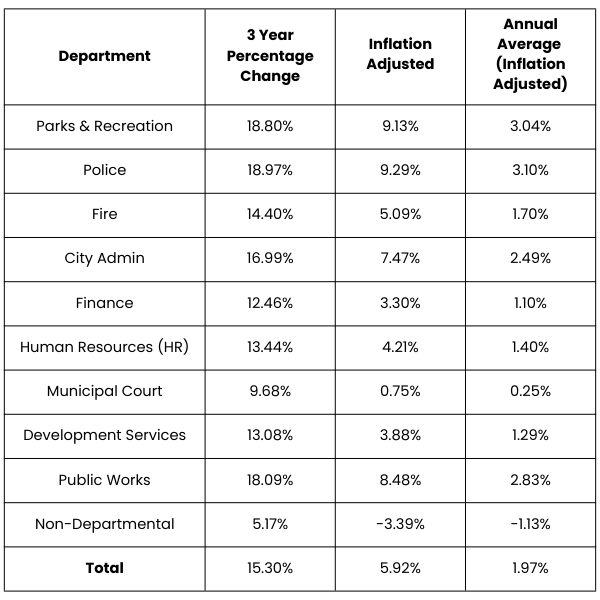
Meanwhile, the General Fund budget is growing at an average annual rate that exceeds inflation by 1.97%. Declining revenue and increasing expenses is not sustainable. The city’s funding is much more complex than a single millage rate and is derived from multiple sources. This discussion focuses on the source that most directly impacts individual citizens – the property tax.
The millage rate is important, but for homeowners, the more significant component in determining our property tax liability is the homestead exemption. Marietta and Cobb County offer a floating exemption that increases by the amount of assessment increases. This allows the taxable basis in your home to remain unchanged regardless of increases in your home’s value.
This floating exemption is the crown jewel of Marietta’s property tax structure. If you have lived here for 25 years, the net assessed value on which you pay taxes has not changed and, all other things being equal, you are paying a much lower tax bill than your neighbors who purchased their home last year.
For example, a quick search of Marietta tax records shows that the owner of a $1.2 million home purchased in 1997 paid $288 in annual general fund taxes for 2025 while the owner of a $415,000 rental duplex paid $463. This structure rewards longevity and keeps taxes low for long-time residents, but in times of stagnant growth, lower turnover, and declining numbers of renters, it will not work.
For this tax structure to be sustainable, it requires rental and commercial properties to provide the necessary increases in the Net Tax Digest that allow for growth in the city’s budget.
In 2004, Marietta adopted a strategy of reducing the percentage of rental units in the city. This strategy reduced the percentage of renters from 62.4% in 2000 to 48.7% in 2025. Only now, after running off the renters who have been subsidizing our property tax exemptions, does it become apparent that if we haven’t killed the golden goose, we surely winged it.
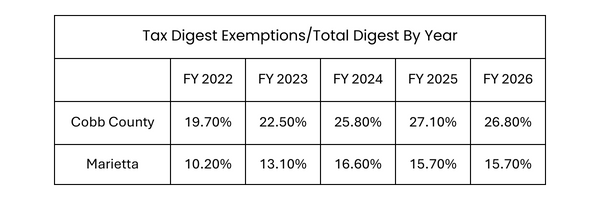
Fewer renters mean more people with homeowner exemptions. The following table shows the value of our total homestead exemptions as a percentage of the total Tax Digest in recent years.
There are three possible solutions to this problem:
1: We could increase the millage rate to account for inflation.
This strategy is unacceptable. Having the lowest millage rates in the metro area attracts new residents and is an expectation of existing residents.
2. The second option is to cut expenses.
The table below lists the actual and inflation-adjusted increase in the budget for each city department over the past three years.
In each case, the cost increase has exceeded the inflation rate, but the largest offenders are the areas that we value the most: Police and Parks and Recreation. The third-highest departmental growth is Public Works, which can be expected for a city with an aging infrastructure.
Cuts to these services would have a negative impact on population growth, quality of life, and by extension, real estate values. Admittedly, every budget can stand some level of cuts (like last year’s inexplicable 60% increase for the City Attorney), but budget cuts alone will not fix this problem.
3: This leaves the third option – increase the Tax Digest through the implementation of a plan that provides for diversity of home ownership, affordable housing, and commercial development.
We need to choose a path: i) growth, ii) reduction in services, or iii) higher millage rates. The failure to choose is a vote for higher taxes.
Elected officials need to focus solely on how the city benefits from proposed development. In the recent election, homebuilders and zoning attorneys made significant contributions to city council and mayoral candidates. Council members need to be free of influence from anyone other than their constituents.
In conclusion, I (Richard Gaudet) would prefer to forego the lipstick of bike lanes and freshly painted crosswalks in favor of council members that take a big picture view before it is too late to avoid tax increases. This means increased access to housing to stop the runoff of the very people who have been subsidizing our property taxes for decades. Anyone pledging to keep taxes low while increasing city services are kidding you and themselves.
— — — — — — — — —
The above article, written by Nora’s husband Richard Gaudet, was published in the Marietta Daily Journal on November 21st, 2025. Subscribers to the Marietta Daily Journal can view the article on the MDJ’s website.
Stay up to date on all campaign events, volunteer opportunities, election updates, and more